
Calm is the First Skill: Why Emotional Regulation Matters More than Obedience
Why Obedience Isn’t the Foundation: Dogs Learn Through Their Nervous System
I’ve spent many years with dogs: my own, my clients’, and the dogs who surprised me, challenged me, and taught me who I am. And if there’s one thing I’ve learned after all this time, it’s this: most of us start in the wrong place. We rush to obedience. We rush to “sit,” “stay,” “heel,” “leave it.” We rush to control the behavior we can see, instead of supporting the emotions we can’t. This is the heart of calm dog training, where emotional regulation becomes the foundation for everything else.
Dogs don’t learn in a straight line. They learn when their nervous system is regulated enough to take in information.
A dog who is overwhelmed can’t focus. A dog who is anxious can’t think. A dog who is overstimulated can’t access the part of their brain that makes learning possible.
And yet, for so long, we’ve treated obedience as the foundation — as if behavior exists in a vacuum, separate from emotion. It doesn’t. It never has.
The truth I’ve learned, again and again, is simple:
It’s not about teaching “sit.” It’s about helping the dog calm down enough so their brain can learn to sit on cue.
Once you see this, you can’t unsee it. Once you feel it, you can’t go back.
Because everything changes when you stop trying to control a dog’s movements and start supporting their emotional state. Calm isn’t a bonus. Calm isn’t a luxury. Calm is the first skill. It’s the skill that makes all the others possible.
Calm Creates Access: How Emotional Regulation Expands a Dog’s World
One of the first things I noticed after I started paying attention to emotional regulation was how much access calmness gives a dog. Calm isn’t just a training goal. It’s a passport that opens doors, literally and figuratively.
I’ve met so many dogs over the years who were perfectly sweet, perfectly social, perfectly capable companions… but they struggled to settle. They couldn’t turn the dial down. They couldn’t pause. They couldn’t take a breath. And because of that, their world stayed small.
A dog who can settle gets to be an office dog. A dog who can settle gets invited into stores. A dog who can settle meets more people, visits more places, and experiences more of the world.
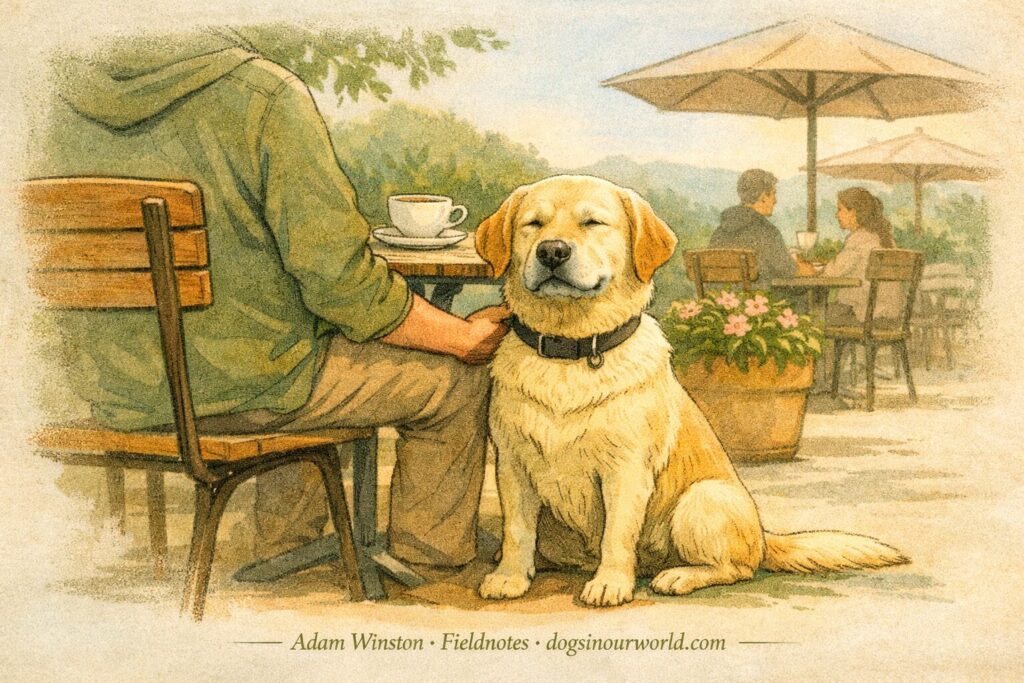
It’s not because they’re “better behaved.” It’s because they’re emotionally available to participate in the world without overwhelming themselves or others. This is the core of calm dog training: helping a dog access the part of their brain that can learn.
I’ve seen the opposite, too. I’ve seen dogs who never get the chance to show how wonderful they are because their excitement gets in the way. They pull too hard, bark too loudly, wiggle too intensely, or can’t stop long enough to take in what’s happening around them. And so their humans, understandably, avoid situations that feel unpredictable or stressful.
But here’s the part that changed everything for me:
Calm can be a personality trait and a skill.
Like any skill, calmness can be taught, practiced, reinforced, and strengthened over time.
Once I understood that, I stopped seeing “hyper” dogs as limited and started seeing them as untrained athletes. They were dogs with potential, full of energy, and fully capable of learning to regulate themselves with the right support.
Calm creates access. And access creates a bigger, richer, safer life for the dogs in our world.
Emotional Regulation as Social Responsibility: Why Dysregulation Affects Everyone
The more time I spent watching dogs in real environments such as parks, sidewalks, cafés, lobbies, and waiting rooms, the more I realized something important: emotional regulation is not just a personal skill. It is a social responsibility.
A dysregulated dog not only struggles internally. Their internal state spills outward and affects the dogs near them, the people near them, and the entire social environment they are trying to participate in.
I think about the dog parks I have observed over the years. There is always that one dog, often a young shepherd, doodle, or herding breed, who barrels into the space like a pinball. Not aggressive. Not “dominant.” Just overwhelmed. Too much energy, too much excitement, and too little ability to pause or read the room.
I remember watching a German Shepherd at the dog park who was not trying to be pushy. He simply could not slow down. His body was moving faster than his brain. He ignored calming signals, blew past boundaries, and escalated play into conflict without meaning to. The humans around him did what many people do: they corrected the behavior after it happened.
But corrections do not teach emotional skills. They do not teach a dog how to regulate. They do not teach a dog how to pause, soften, or reset.
What that dog needed was not punishment. He needed a break. A moment to breathe. A chance for his nervous system to come back online. He needed someone to help him regulate, not reprimand him for failing to do it alone.
When dogs learn to settle, the entire environment becomes safer, calmer, and more enjoyable. Emotional regulation is not only for the dog’s benefit. It is for the benefit of every dog and human sharing space with them.
Calm is not just personal. Calm is communal.
Emotional regulation is not only for the dog’s benefit.
Adam Winston – Dogs in our world
Nature + Nurture: Genetics, Learning, and the Trainability of Calm
The more I learned about canine behavior, the more I realized that emotional regulation sits at the intersection of two powerful forces: genetics and learning.
Every dog enters the world with a temperament influenced by their biology. Some are naturally more cautious. Some are naturally more social. Some carry a little extra spark, the kind of excitability that creates wonderful athletes and joyful companions, yet also makes them more prone to getting overwhelmed.
But here’s the part that changed the way I see dogs forever:
Genetics may set the baseline, but learning shapes the outcome.
A fearful dog can learn confidence. An excitable dog can learn to settle. A sensitive dog can learn resilience. A high‑drive dog can learn to pause, breathe, and re‑engage with intention.
Emotional regulation isn’t fixed. It’s not destiny. It’s not a personality verdict. It’s a trainable skill — one that grows through experience, repetition, and support.
When I finally understood this, I learned the value in avoiding labels such as “hyper,” “reactive,” or “too much,” and started seeing them as learners. Dogs who simply hadn’t been taught how to downshift. Dogs whose nervous systems needed guidance, not judgment.
And once you see emotional regulation as a skill, not a trait, everything opens up. You stop asking, “Why is he like this?” and start asking, “How can I help him learn a different way to be?”
What Calm Dog Training Looks Like: The Observable Behaviors of a Regulated Dog
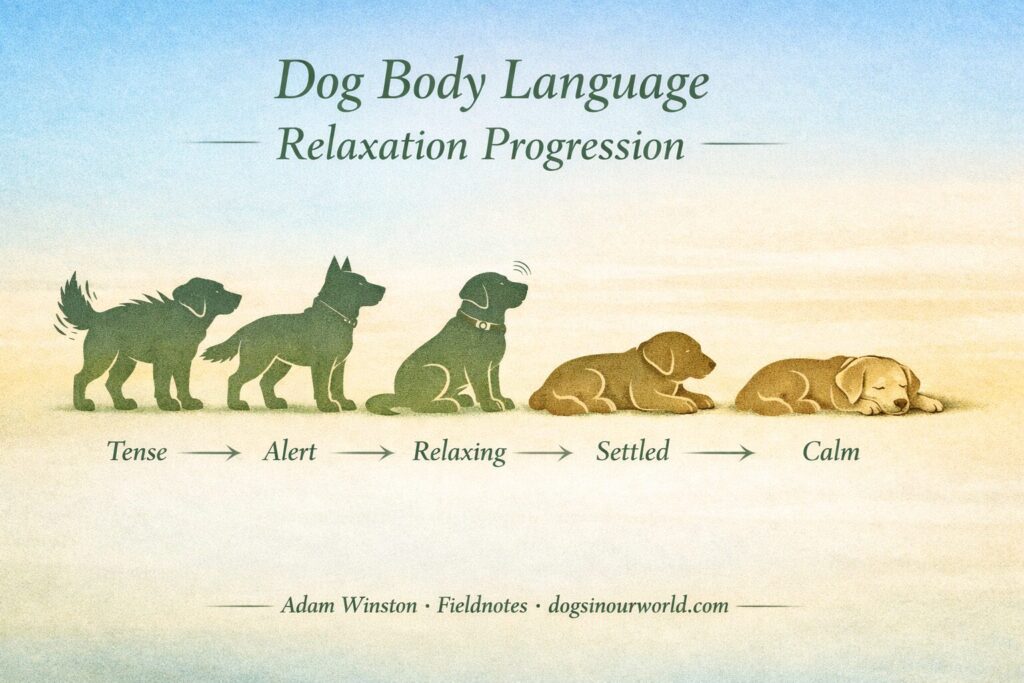
For a long time, “calm” felt like a vague concept. Something people described but rarely defined. But once I started paying attention to the behavioral markers of emotional regulation, everything became clearer. Calm isn’t abstract. Calm is observable. Calm is measurable. Calm is something you can actually see in a dog’s body.
A regulated dog doesn’t just “act calm.” They show calm through dozens of small, physical signals that tell you their nervous system is settling.
I look for things like:
- Sitting or softening into a stand instead of pacing or bouncing
- Breathing that slows from rapid panting to steady inhales and exhales
- A relaxed mouth instead of a tight, pinched one
- Ears that soften instead of locking forward
- Four paws on the floor instead of jumping or frantic movement
- Eyes that shift from scanning to gentle engagement
- A body that loosens instead of bracing or leaning into tension
These aren’t obedience behaviors. They are regulatory behaviors and signs that the dog’s nervous system and ability to learn are coming back online.
And here’s the part that still amazes me: You can shape these behaviors the same way you shape any other skill.
If a dog offers a micro‑moment of softening, I mark it. If they take a relaxing breath, I reinforce it. If they choose to pause instead of react, I celebrate it with pride.
Over time, these tiny moments add up. The dog learns that calm is safe, calm is rewarding, and calm is a way of being that opens up their world.
Calm isn’t magic. Calm is a behavior. And behavior can be taught.
The Moment a Dog Taught Me to Breathe: A Story About Co‑Regulation
Many years ago, long before I became a behaviorist, I was a dog sitter in Philadelphia. I had a wonderful Border Collie staying with me for the weekend. He was bright, friendly, eager, and the kind of dog who makes you feel like you’ve known them forever. We’d just finished an exhausting two‑plus‑mile walk through South Philly, weaving past stoops and corner stores, both of us ready to collapse into the quiet of my home.
But when I reached my front door, I realized something: I didn’t have my keys.
The frustration hit me fast. I was tired, sweaty, hungry, and completely in my own head. Without thinking and without even remembering there was a dog beside me — I slammed the metal screen door.
The sound was sharp. The reaction was immediate.
The Border Collie’s eyes widened. His body stiffened. He looked like he was about to bolt. In one split second, my frustration had become his fear.
And something in me dropped.
My body softened before my brain caught up. I lowered myself, almost instinctively, as if to say, I’m sorry. That wasn’t about you. Compassion rushed in. Not the kind that feels noble, but the kind that feels humbling. The kind that makes you realize you weren’t showing up the way you thought you were.
I apologized to him softly. I offered him one of his favorite treats. And then we walked, calmly, to a friend’s house down the block who still had a spare key from the last time they’d house‑sat for me. The crisis I’d created in my mind wasn’t a crisis at all.
But the lesson stayed with me.
That moment taught me that my internal world becomes a dog’s external world. That my frustration doesn’t solve problems; it clouds them. And that I can’t expect a dog to offer regulated behavior if I’m not offering it myself.
The first lesson a dog ever taught me is the lesson dogs continue to teach me today: the more I practice calming myself at the right time, the better I get at doing it. Same with dogs.
The crisis I’d created in my mind wasn’t a crisis at all.
adam winston – dogs in our world
The First Skill I Teach: Gentle Eye Contact as Emotional Check‑In
After that moment in Philadelphia, I started paying closer attention to the earliest signs of connection. I began looking for tiny cues that tell me a dog is emotionally available or vulnerable, even for just a second. And over time, I realized something simple but profound:
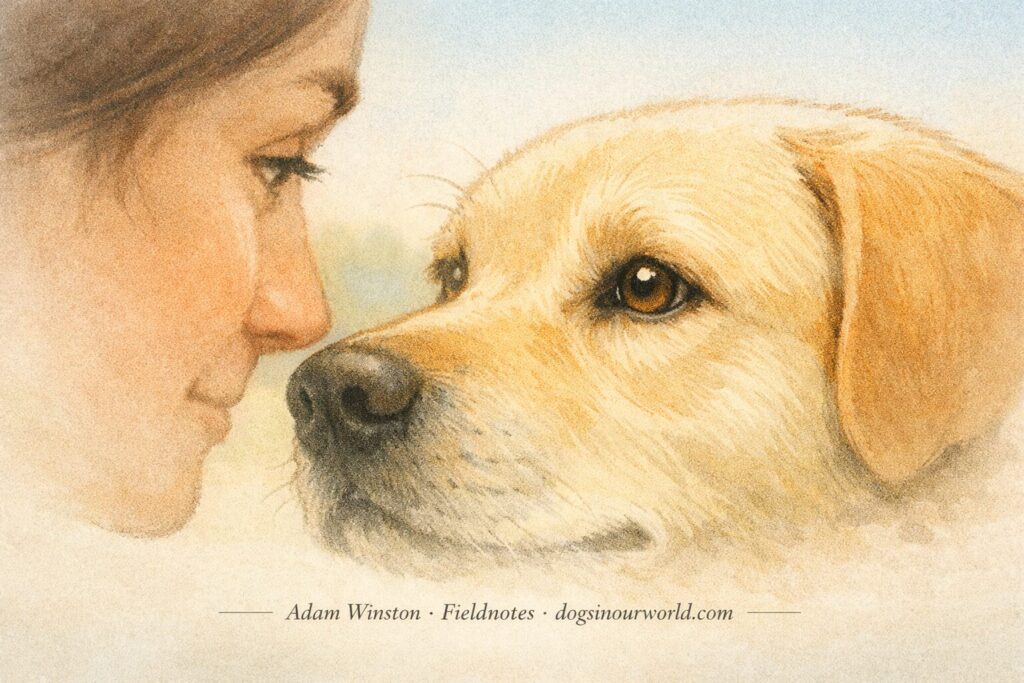
The first skill I teach any dog is gentle eye contact.
Not the rigid, competition‑style “watch me.” Not the intense, locked‑in stare that comes from fixation. Just a soft check‑in. A moment where the dog says, I’m here with you.
That tiny moment tells me everything I need to know about their nervous system. If a dog can offer gentle eye contact, even for half a second, it means they’re not completely overwhelmed. It means they’re not spiraling. It means they’re capable of noticing me, even in a world full of distractions.
And if they can’t offer it? That’s information too. It means they need space, distance, decompression, or support before they can learn anything else.
I teach this skill the same way I teach calm: through micro‑moments. If a dog glances up at me, I mark it. If they soften their eyes, I reinforce it. If they choose connection over scanning the environment, I celebrate it.
Over time, that gentle check‑in becomes a shared language. It becomes a way for the dog to say, I’m okay. And a way for me to say, I’m here with you.
It’s not obedience. It’s communication. It’s co‑regulation. And it’s the foundation for everything that comes next.
Calm Is Shared: How Humans and Dogs Co‑Regulate Together
The longer I’ve worked with dogs, the more I’ve realized that emotional regulation isn’t a one‑way street. It’s not something we teach dogs so much as something we practice with them. Calm is relational. It’s shared. It moves between bodies.
There are moments in my work (and in my life) when I have to remind myself to feel my own feet on the ground. To breathe. To soften my shoulders. To broaden my awareness rather than narrow it. And every time I do, I notice the dog in front of me shift too. Their breathing slows. Their eyes soften. Their body loosens. It’s as if we’re tuning to the same frequency.
Dogs are extraordinary co‑regulators. They read us with a level of sensitivity we rarely give them credit for. They notice when our voice tightens, when our movements get sharp, when our attention scatters. And they respond, not because they’re trying to misbehave or “test” us, but because they’re wired to sync with the emotional states of the beings they depend on.
I think of the Monks of New Skete, not for their training methods, but for the way they wrote about the spiritual dimension of living with dogs. These monks explore the idea that dogs invite us into a calmer, more grounded version of ourselves. I didn’t fully understand that when I first read it. Now I do.
Calm isn’t something I give to a dog. It’s something we create together.
And when we both show up regulated, the relationship becomes clearer, safer, and more connected for both of us.
What Dogs Reveal About Us: Emotional Parallels Between Species
The more I’ve learned about emotional regulation in dogs, the more I’ve had to confront something uncomfortable — and ultimately liberating — about myself. Dogs don’t just respond to our emotions. They reveal them. They reflect them. They hold up a mirror we don’t always want to look into.
I’ve worked with dogs who showed me my impatience. Dogs who showed me my tension. Dogs who showed me my tendency to rush, to overthink, to tighten my voice when I’m overwhelmed. And I’ve worked with dogs who softened me, slowed me, grounded me, and reminded me to breathe.
It’s humbling to realize that the behaviors we label in dogs: reactivity, excitability, avoidance, shutdown, etc., often have human parallels. We get overwhelmed, too. We shut down, too. We react too quickly, or cling too tightly, or lose access to our own calm when life presses in.
And just like dogs, we don’t learn well when we’re dysregulated. We don’t communicate clearly. We don’t problem‑solve effectively. We don’t show up as our best selves.
But here’s the part that keeps me doing this work:
Dogs don’t judge us for it. They respond to what’s real.
Dogs invite us gently, consistently, sometimes inconveniently to regulate with them. To slow down. To soften. To practice the same skills we’re trying to teach.
When I help a dog learn to settle, I’m practicing too. When I help a dog take a breath, I’m taking one with them. When I help a dog feel safe, I’m reminded of what safety feels like in my own body.
Dogs don’t just learn from us. We learn from them… every single day.

Calm Is the First Skill… For Both of Us
After all these years, all these dogs, all these lessons, I’ve come to believe something simple and unwavering:
Calm is the first skill.
Not “sit.” Not “stay.” Not “heel.” Calm.
Because without access to calm, a dog can’t learn. Without access to calm, a dog can’t think. Without access to calm, a dog can’t participate in our world safely or confidently.
Calm is the foundation beneath every behavior we hope to teach. Calm is the nervous system saying, I’m okay. I can handle this. I can stay connected.
And here’s the part that matters most:
Calm is not the dog’s job alone. It’s ours too.
We model it. We practice it. We co‑create it. We repair it when we lose it. We return to it again and again, not because we’re perfect, but because we’re committed.
Dogs don’t need us to be flawless. They need us to be aware. They need us to be responsible for the emotional tone we bring into their world. They need us to understand that regulation is a partnership. It’s a shared skill that grows stronger every time we practice it together.
This article isn’t about obedience. It’s about relationship. It’s about safety. It’s about learning. It’s about becoming the kind of humans that the dogs in our world can trust with their nervous systems.
The first lesson a dog ever taught me is still the one I return to every day:
Calm creates access. Calm creates connection. Calm creates possibility.
Calm is the first skill for both of us.
Author’s Note: Calm is a skill we build together, one moment at a time. If you want a practical way to start teaching that skill, I created a companion piece called Redlight, Greenlight: A Practical Framework for Everyday Dog Handling. It’s the method that changed the way I work with dogs. Please read, comment, and share.
Frequently Asked Questions
It means that before dogs can learn commands or behaviors, they must first access a calm, regulated state. Calmness allows their brain to process information and learn effectively.
Obedience focuses on visible behavior, while emotional regulation focuses on the internal state that makes learning possible. A calm dog can think, focus, and respond; an anxious dog cannot.
Dogs learn best when their nervous system is balanced. Stress, fear, or overstimulation block the parts of the brain responsible for focus and memory, making training ineffective.
Yes. Calmness can be shaped, reinforced, and practiced through small moments of relaxation, breathing, and gentle engagement—just like any other learned behavior.
A regulated dog shows soft eyes, relaxed muscles, steady breathing, and four paws on the floor. These are physical indicators that the nervous system is settling.
A dysregulated dog may bark excessively, jump, pull, or ignore cues. These behaviors are not defiance—they’re signs that the dog’s nervous system is overwhelmed.
A calm dog contributes to a safer, more peaceful environment for other dogs and people. Emotional regulation benefits the entire social space, not just the individual dog.
Genetics set a dog’s temperament baseline, but learning shapes outcomes. Even excitable or sensitive dogs can learn to settle through consistent, supportive experiences.
Humans are co‑regulators. Our tone, movement, and emotional state influence the dog’s nervous system. When we model calm, dogs mirror it.
Start by noticing small moments of relaxation and reinforcing them. Give space, reduce stimulation, and reward calm behaviors consistently.
They describe the spiritual dimension of living with dogs—how dogs invite us into a calmer, more grounded version of ourselves. Calmness is shared between species.
Calm creates access, connection, and possibility. It’s the foundation for learning, safety, and trust—for both dogs and humans.

Adam Winston
Dog Trainer • Animal Behaviorist • Science Communicator
Adam is the founder of Dogs in Our World, where he blends science, storytelling, and compassion to help people understand the dogs they love. His work focuses on fear‑based behavior, trust‑building, and the emotional lives of dogs and their humans.
If you’re navigating behavior challenges or want personalized guidance, Adam offers private sessions, AKC evaluations, and education‑focused consultations.



The FAQ at the end of the articles is a great summary. Really helps digest the informaiton.