Your Dog Isn’t Stubborn: The Science of Canine Motivation
Introduction: The Stubborn Dog Myth
Your dog isn’t ignoring you. They’re not testing you, defying you, or plotting a silent rebellion. When a dog seems “stubborn,” what you’re really seeing is a moment where canine motivation, clarity, or emotional readiness has fallen out of sync. This disconnect can feel frustrating and confusing, especially when you’re trying your best to communicate and connect.
Picture this: You call your dog to come inside, but they freeze or turn away. Or you give a cue, and they simply don’t respond. It’s easy to jump to the conclusion that your dog is being difficult or stubborn. But what if that label is more about our human perspective than the dog’s actual experience?
This myth of stubbornness persists because it’s a simple explanation for something more complex. It’s a way to make sense of moments when things don’t go as planned. But science tells us a different story—one rooted in motivation, emotional state, and learning history. Understanding these factors can transform frustration into empathy and open the door to more effective, compassionate training.
One of my favorite sayings to tell clients is a variation of, “We can’t get frustrated with a dog if we haven’t trained them to do what we want.” For example, I can’t get frustrated with a dog for not coming when called from outside if I haven’t taken the time to properly ensure that the dog KNOWS how to properly recall from the backyard.
In this article, we’ll explore the real science behind canine motivation and why the stubborn dog is a myth worth busting. You’ll learn how to see your dog’s behavior through a new lens—one that honors their needs and helps you build a stronger, more trusting partnership.
Let’s start by unraveling the layers beneath what looks like stubbornness and discover the true drivers of your dog’s behavior.
What Motivation Really Is
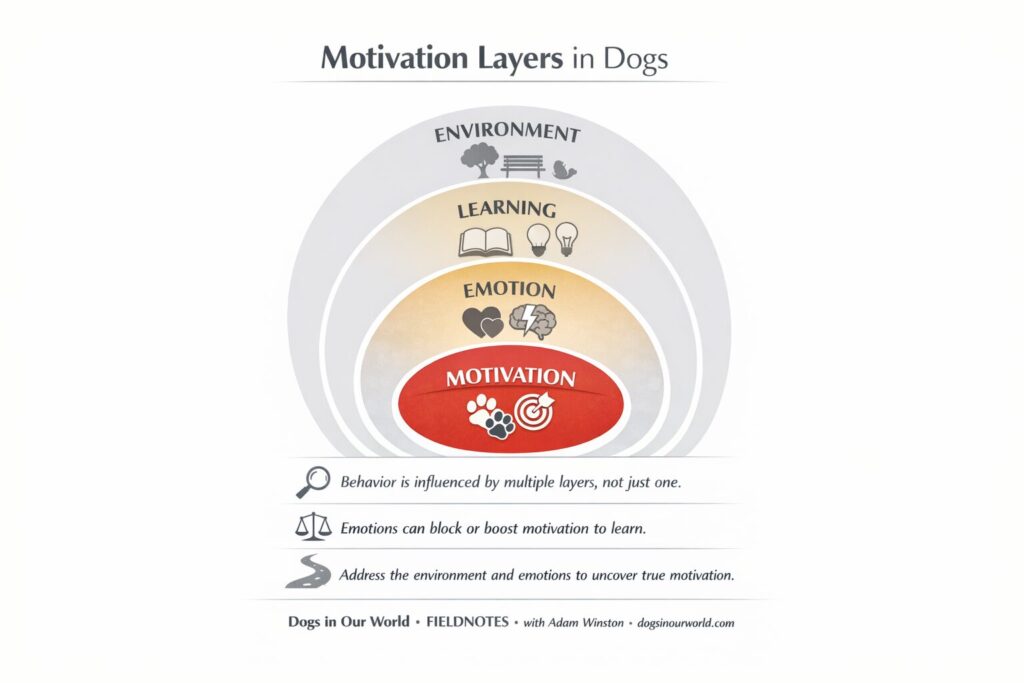
Motivation is the internal drive that prompts a dog to act, guiding their choices and behaviors in any given moment. It’s the invisible force behind why a dog might eagerly chase a ball, ignore a cue, or decide to explore a new scent instead of coming when called. Understanding motivation means recognizing that it’s not a simple, one-dimensional concept but a complex interplay of internal and external factors.
Internal motivators come from within the dog. These motivators can include hunger, thirst, curiosity, or emotional states such as excitement or anxiety. These intrinsic drives influence how a dog perceives and reacts to their environment. For example, a dog that is hungry may be more motivated by food rewards, while a dog feeling anxious might be less responsive to cues altogether.
External motivators are the environmental factors that encourage or discourage behavior. These include treats, toys, praise, or even the presence of other animals or people. External motivators can vary widely in value depending on the dog’s preferences and current state. A favorite toy might be highly motivating in a calm setting but less so in a highly distracting environment.
Crucially, dogs often face competing motivations simultaneously. A dog might want to come when called but also be drawn to an intriguing smell or a nearby dog. These competing motivators create a push-and-pull dynamic that influences behavior. When the motivation to explore or engage with something else outweighs the motivation to respond to a cue, the dog appears “stubborn” or “disobedient.”
Recognizing this complexity helps shift the perspective from blaming the dog to understanding the underlying motivational landscape. It opens the door to more effective training strategies that consider both internal states and external influences, tailoring approaches to what truly drives each individual dog.
In the next section, we’ll explore the emotional layer of motivation—how stress, fear, and arousal levels shape what motivates a dog and how they respond to cues.
The Emotional Layer
Motivation isn’t just about rewards or consequences; it’s deeply intertwined with a dog’s emotional state. Stress, fixation, and fear can dramatically alter how a dog perceives cues and decides whether to respond. When a dog is stressed, their brain prioritizes safety and survival over obedience, making it harder for them to focus or engage.
Arousal levels also play a crucial role. According to the Yerkes-Dodson law, there’s an optimal level of arousal for performance. Too little arousal can lead to boredom or disengagement, while too much can cause hyper-reactivity. A dog that’s overly aroused might seem “stubborn” because their nervous system is flooded, making it difficult to process cues or make thoughtful choices.
Dogs may respond to emotional overload in different ways. Some shut down, becoming unresponsive or frozen, while others avoid the situation by ignoring cues or fleeing. Both shutdown and avoidance are survival strategies, not acts of defiance.
Understanding this emotional layer helps shift the perspective from blaming the dog to recognizing their internal experience. It also highlights the importance of creating training environments that support emotional regulation through calming signals, breaks, and predictable routines to help dogs stay within their optimal arousal or learning zone.
By tuning into your dog’s emotional state, you can better interpret their behavior and adjust your approach. This emotional awareness is a key step toward building trust and motivation that lasts beyond treats and commands.
By tuning into your dog’s emotional state, you can better interpret their behavior and adjust your approach.
adam winston – dogs in our world
The Learning Layer
Canine motivation is deeply shaped by a dog’s learning history. It’s shaped by the cumulative experiences that teach them what to expect and how to respond. Reinforcement history plays a central role: behaviors that have been consistently rewarded are more likely to be repeated, while those met with inconsistent or no reinforcement may fade or become unreliable.
Cue clarity is another critical factor. Dogs rely on clear, consistent signals to understand what’s expected. Ambiguous or conflicting cues can confuse dogs, leading to hesitation or apparent disobedience. Ensuring that cues are distinct and predictable helps dogs respond with confidence.
Generalization challenges also influence motivation. Dogs must learn to apply learned behaviors across different contexts, environments, and distractions. Without sufficient practice in varied settings, a dog may perform well at home but struggle elsewhere, which can be mistaken for stubbornness. This study from 201l examines how dogs are what I often call “contextual learners”.
Predictability in training routines and environments supports motivation by reducing uncertainty. When dogs know what to expect, they can focus their energy on responding rather than processing new or confusing information.
Understanding the learning layer encourages trainers to review reinforcement patterns, clarify cues, and diversify training contexts. This approach builds a solid foundation for motivated, reliable behavior that extends beyond the training session.
The Environmental Layer
Motivation doesn’t happen in a vacuum. The environment around your dog plays a huge role in shaping their behavior and willingness to respond. Distractions, sensory overload, and sudden context shifts can all pull a dog’s attention away from cues and training, making them seem unmotivated or stubborn.
Distractions come in many forms: other animals, people, noises, smells, or even moving objects. Each distraction competes for your dog’s attention, often overpowering the value of a cue or reward. For example, a squirrel darting across the yard can instantly eclipse the appeal of a treat or toy, no matter how well-trained your dog is.
Sensory load refers to the cumulative effect of all the stimuli your dog is processing at once. A busy park with loud sounds, strong smells, and lots of movement can overwhelm a dog’s nervous system. When sensory load is high, dogs may shut down, freeze, or become hyperactive, all of which interfere with their ability to focus and respond.
Context shifts happen when a dog moves from one environment to another with different rules, distractions, or expectations. A dog that responds reliably at home may struggle in a new park or a friend’s house because the cues and reinforcements don’t generalize well. These shifts require dogs to reorient and relearn, which can look like stubbornness or confusion.
Understanding the environmental layer helps owners create training and living spaces that support motivation. Managing distractions, gradually increasing sensory challenges, and practicing cues in varied contexts can build a dog’s confidence and responsiveness.
By tuning into how environment shapes behavior, you can better support your dog’s motivation and reduce those frustrating moments when they seem to “ignore” you.
Managing distractions, gradually increasing sensory challenges, and practicing cues in varied contexts can build a dog’s confidence and responsiveness.
adam winston – dogs in our world
Practical Tools for Real Life
Helping your dog stay motivated and engaged requires practical tools that honor their unique needs and experiences. Here are several strategies grounded in science and real-world success to build motivation effectively and compassionately.
Motivation Mapping
Start by identifying what truly motivates your dog. Motivation mapping involves observing your dog throughout the day to pinpoint high-value rewards, preferred activities, and natural interests. This personalized map helps you tailor training and interactions to what genuinely drives your dog, making cues and tasks more appealing.
Reinforcement Upgrades
Not all rewards are created equal. Reinforcement upgrades mean elevating the value of what you offer your dog based on context and emotional state. For example, a treat that works well at home might need to be replaced with a higher-value reward like a favorite toy or a game during high-distraction outings. Varying reinforcement keeps your dog curious and eager.
Understanding what truly motivates your dog goes beyond just offering treats. Dogs naturally choose the tastiest, comfiest, and easiest options available. For instance, most dogs prefer a cozy couch over a hard floor for resting, or a juicy piece of steak over a single kibble.
Take Gorbi, my Bassett Hound, who doesn’t need food rewards to wait patiently at the door before a walk. The movement of the door opening itself is a powerful motivator. Simply placing my hand on the door handle signals Gorbi to stay, while stepping back signals it’s time to calm down.
Similarly, Meka, a shy dog, was hesitant around new people until she was hand-fed high-value human foods like peanut butter and roast beef instead of her typical everyday dog treat. This approach helped her overcome fear and build trust.

These examples highlight the importance of identifying all motivators in your dog’s life. High-value human foods can be powerful training tools when used appropriately, especially for new or challenging behaviors. However, it’s essential to use them sparingly and in controlled contexts to avoid creating unwanted habits like begging.
Remember, the value of a reward is relative to the dog’s preferences and the situation. What works as a high-value reward in one context may not be as effective in another. Tailoring rewards to your dog’s unique motivators enhances engagement and learning.
Tone of Voice Insights
The way you use your voice can significantly impact your dog’s motivation and responsiveness. Modulating your tone and knowing when to add energy and when to calm down helps your dog stay engaged and focused.
For example, a lighthearted, enthusiastic tone can encourage a dog to come when called, while a calm, steady voice may help a dog settle and focus during training.
Be cautious with overusing high-pitched praise (HPP), which can sometimes overwhelm or excite a dog excessively. Instead, use it sparingly and strategically.
Remember, effective communication is about matching your vocal energy to the moment and your dog’s emotional state. This balance supports motivation and builds trust.
The Three D’s Framework: Distance, Duration, Distraction
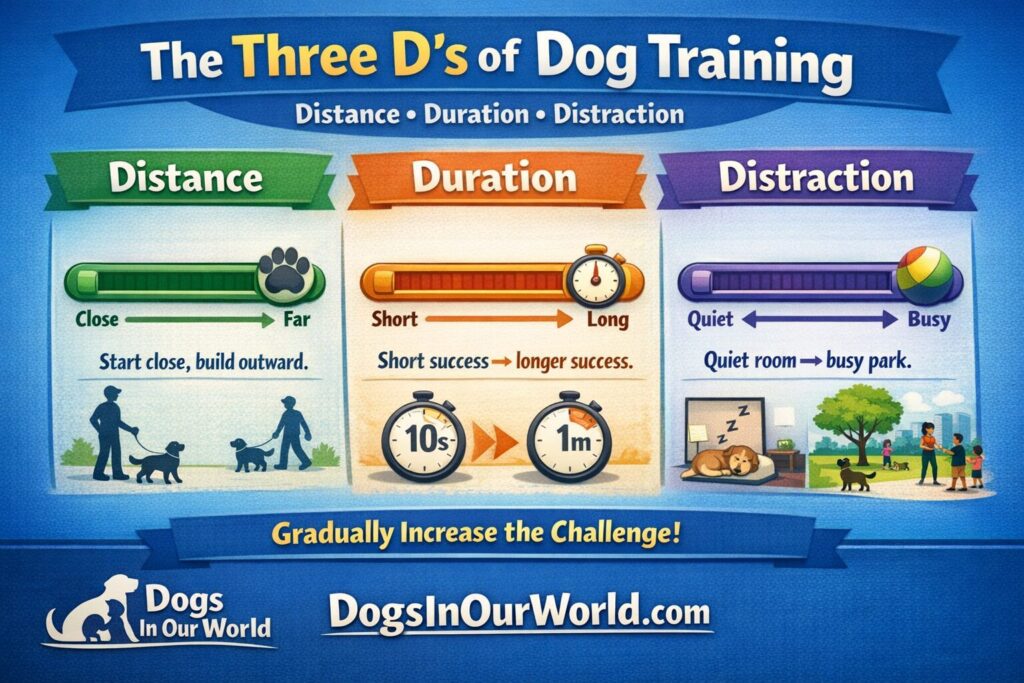
One of the most effective ways to reduce frustration and build reliable behaviors is by breaking down lessons into manageable parts using the “Three D’s”: Distance, Duration, and Distraction.
Distance
Start training cues at close range, such as one or two feet, and gradually increase the distance as your dog becomes more reliable. For example, ensure your dog can come when called from five feet before extending to twenty feet or more.
Duration
Build your dog’s ability to maintain behaviors over time. If your dog struggles to hold a “stay” for twenty seconds, step back to shorter durations like ten or fifteen seconds and gradually increase as confidence grows.
Distraction
Begin training in low-distraction environments and slowly introduce distractions, such as background noise or other people, increasing complexity only as your dog remains successful. This incremental approach helps prevent overwhelm and builds focus.
Breaking Tasks Down
Complex behaviors can overwhelm dogs, especially if motivation is low or emotional states are heightened. Breaking tasks into smaller, manageable steps allows your dog to experience success incrementally. Celebrate each step with clear cues and rewards, building momentum and confidence.
Using Momentum
Momentum is the energy and motivation that builds as your dog experiences repeated success. Use this by chaining simple behaviors together or following a successful cue with another easy task. Momentum helps maintain engagement and reduces the chance of frustration or shutdown.
Redlight/Greenlight Tie-In
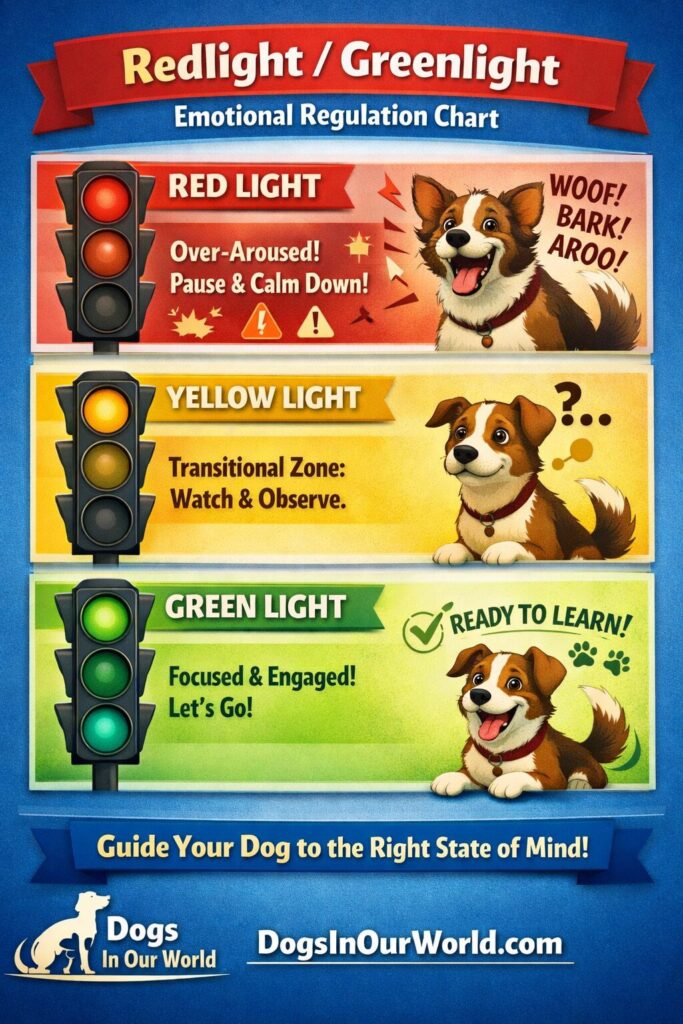
Incorporate the redlight/greenlight concept to help your dog regulate arousal and focus. Use clear signals to indicate when it’s time to engage (greenlight) and when it’s time to pause or calm down (redlight). This approach supports emotional regulation and helps your dog stay within their optimal motivation zone.
By applying these practical tools, you create a training environment that respects your dog’s emotional and motivational landscape. This foundation not only improves responsiveness but also deepens your partnership, turning moments of frustration into opportunities for connection and growth.
Case Study
When Max, a lively border collie, was labeled “stubborn” by his owner, Sarah, frustration often filled their training sessions. Max would freeze or ignore commands, especially during walks, leaving Sarah feeling defeated and questioning her approach. But the turning point came when Sarah began to see beyond the label and started exploring the science of motivation.
Sarah noticed that Max’s behavior shifted dramatically depending on his emotional state and environment. On calm mornings, he was eager and responsive, but in busy parks, distractions overwhelmed him. Understanding that Max wasn’t being defiant but rather navigating competing motivations and sensory overload changed everything.
She began mapping Max’s motivators, discovering that his favorite game of fetch and certain high-value treats sparked his enthusiasm more than generic rewards. By breaking down commands into smaller steps and using clear, consistent cues, Sarah helped Max build confidence incrementally.
Incorporating “redlight/greenlight” signals allowed Max to regulate his arousal, knowing when to engage and when to relax. Gradually, Sarah introduced distractions in controlled ways, helping Max generalize his training to new environments.
The transformation was profound. Max went from being labeled “stubborn” to a dog whose behavior reflected his unique needs and experiences. Sarah’s frustration gave way to empathy and partnership, and their bond deepened.
This case illustrates how understanding motivation, emotional layers, and environmental factors can turn moments of resistance into opportunities for connection and growth. It’s a reminder that beneath every so-called stubborn dog is a complex, motivated individual seeking clarity and support.
Closing: A More Compassionate Lens
Reframing stubbornness is not just about changing a word. It’s about shifting how we see and relate to the dogs in our world. When we move beyond frustration and blame, we open the door to empathy and understanding. Recognizing that what looks like stubbornness is often a complex mix of motivation, emotion, and environment empowers us to respond with patience and clarity.
This new lens invites us to observe our dogs with curiosity rather than judgment. It encourages us to consider their unique experiences and needs, fostering a partnership built on trust rather than control. As you apply the insights from this article, you’ll find that moments of resistance become opportunities for connection and growth.
Remember, motivation is not fixed. It’s dynamic and influenced by many factors. By tuning into your dog’s emotional and motivational state, you can create training and living environments that support their success and well-being.
Ultimately, this compassionate approach transforms the way we communicate with our dogs. It replaces the myth of stubbornness with a science-based understanding that honors your dog’s individuality and strengthens your bond. Embrace this perspective and watch your partnership flourish in ways you never imagined.
Frequently Asked Questions
Often, what appears as stubbornness is actually a mismatch in motivation, clarity, or emotional readiness. Dogs aren’t defiant; they may be distracted, stressed, or confused.
Motivation is the internal drive that guides a dog’s choices. It can be influenced by hunger, curiosity, emotional state, and external rewards like treats or toys.
Yes, stress prioritizes safety over obedience, making it harder for dogs to focus or respond to cues.
It describes the optimal level of arousal for performance. Too little arousal leads to disengagement, too much causes overwhelm, both affecting behavior.
Dogs may struggle to generalize learned behaviors across different contexts, leading to confusion or apparent stubbornness.
Consistently rewarded behaviors are more likely to be repeated, while inconsistent reinforcement can cause unreliable responses.
Distractions compete for a dog’s attention and can overpower the value of cues or rewards, reducing responsiveness.
It’s observing your dog to identify high-value rewards and interests, helping tailor training to what truly motivates them.
Rewards can be upgraded based on context and emotional state, using higher-value treats or toys during challenging situations.
Modulating tone helps maintain engagement and focus. Overusing high-pitched praise can overwhelm some dogs.
Distance, Duration, and Distraction—breaking down training into manageable parts to build reliable behaviors.
It helps dogs regulate arousal and focus by signaling when to engage and when to calm down, supporting emotional regulation.

Adam Winston
Dog Trainer • Animal Behaviorist • Science Communicator
Adam is the founder of Dogs in Our World, where he blends science, storytelling, and compassion to help people understand the dogs they love. His work focuses on fear‑based behavior, trust‑building, and the emotional lives of dogs and their humans.
If you’re navigating behavior challenges or want personalized guidance, Adam offers private sessions, AKC evaluations, and education‑focused consultations.